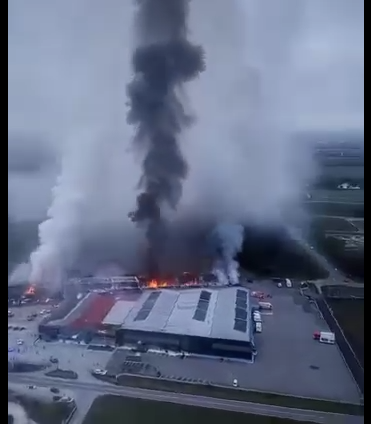
By the time the afternoon light had begun to soften and stretch across the skyline of Millharbor, what had started as an ordinary day had already begun to fracture into something unrecognizable. The city, usually defined by its steady rhythm of commerce, movement, and the constant hum of harbor life, was instead marked by confusion,…
The McAllister Textiles Building, once a proud symbol of the city’s manufacturing history, stood at the center of this unfolding crisis. For decades, its brick façade and towering structure had represented stability and employment for generations of workers. On this particular day, however, it no longer resembled a place of production or purpose. By late afternoon, it had transformed into something far more tragic—a hollowed structure consumed by relentless fire, its internal framework exposed like a fragile skeleton stripped of protection.
Flames surged through the building’s broken windows, no longer contained by walls or purpose. They erupted outward in bursts of orange and red, flickering violently against the surrounding streets. The glass panes, once transparent barriers between interior workspaces and the outside world, had become fractured vents through which heat and fire escaped with force. From a distance, it appeared as though the building itself was exhaling destruction into the city air.
Only hours earlier, the surrounding streets had been filled with everyday life. Vendors had called out to passing customers, laughing and negotiating over goods, sharing jokes and conversations that now seemed distant and unreal. The contrast between then and now was almost incomprehensible. Where there had been routine commerce and familiar exchanges, there was now smoke drifting through the air, curling around streetlights and signposts, muting color and sound alike.
As the fire intensified, emergency responders arrived in waves. Sirens echoed through the city, growing louder and more urgent as they converged on the industrial district. Fire crews rushed to establish control lines, deploying hoses and equipment with practiced speed. Yet even their experience and coordination were challenged by the scale and unpredictability of the blaze. The fire did not remain confined to a single point; it moved with a kind of restless intelligence, feeding on materials within the structure and pushing outward wherever it found weakness.