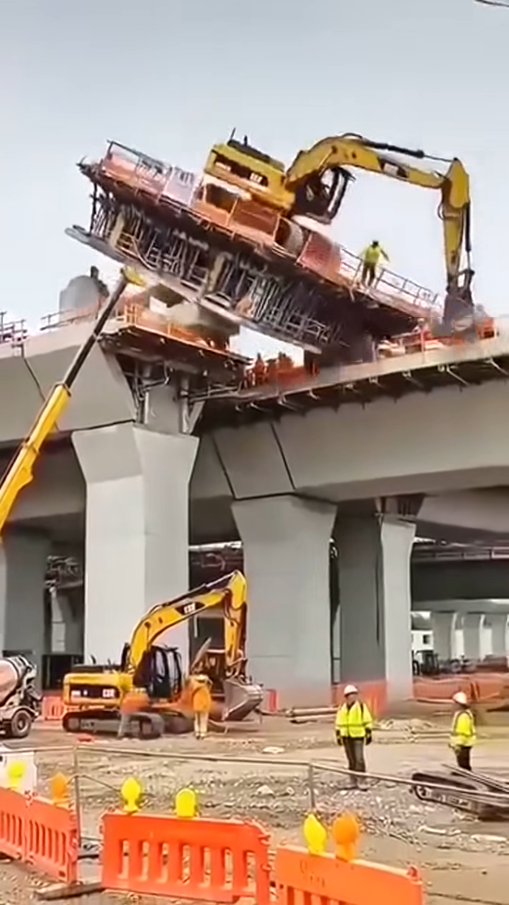
They would not remember the beginning as a visual moment. It would not be the sky, or the road, or the traffic around them that stayed in their minds. Instead, it would be the sound. A low, unnatural groan—deep enough to feel more than hear. It did not belong to any engine, any passing truck,…
The Moment the Highway Gave Way: A Sudden Collapse in Real Time
At first, it did not register as danger. Sound often lies in ordinary environments; it blends into the background of travel, radio noise, tires rolling over asphalt, and the distant hum of daily movement. But this sound was different. It carried weight. It pressed against the air, vibrating through metal, glass, and bone in a way that suggested something fundamental was failing just beneath perception.
Only seconds later did understanding begin to form.
The road shifted.
Not dramatically at first—just a subtle, unsettling movement, like the surface of a calm lake disturbed from underneath. Then the motion grew stronger, more deliberate, as though the structure supporting the highway was no longer stable. Cracks began to appear, jagged lines forming across the pavement as if drawn by an invisible force pulling everything apart from below.
In that moment, ordinary travel turned into instinct.
There was no time for rational thought, no structured decision-making. The body reacted before the mind fully accepted what was happening. Feet pressed harder against pedals, hands tightened around the steering wheel, and eyes locked forward in a sudden, desperate attempt to find a path that might still exist seconds from now.
Behind the vehicle, the road was breaking apart.
Large sections of concrete shifted out of alignment, rising and tilting like unstable platforms losing their grip on reality. What had once been a continuous stretch of highway became fragmented in an instant, each piece behaving as though gravity itself had changed its rules. The illusion of stability vanished completely, replaced by a violent uncertainty.
Vehicles nearby reacted in their own ways—some swerving, others stopping abruptly, tires skidding against collapsing asphalt. The usual order of traffic dissolved into scattered motion, each driver forced into a split-second calculation of survival. Horns sounded briefly, but even those noises were swallowed by the overwhelming collapse of the structure beneath them.
The sensation inside the vehicle was disorienting. It was not just fear, but a layered awareness of vulnerability: the realization that something normally permanent had become fragile. Roads are expected to hold. Bridges are assumed to endure. Highways are trusted without question. When that trust breaks, the mind struggles to replace it with anything else.
As the collapse spread backward along the roadway, the air filled with motion that no one had prepared for. Dust rose in sudden bursts. Pieces of concrete fractured and dropped away, disappearing into depths that were not meant to be visible. Metal barriers twisted like thin wire under pressure, bending into shapes that no longer served any protective purpose.
In the midst of it all, people reacted not as isolated individuals but as fragments of a shared emergency. Some ran toward voices calling for help, while others ran away from what they could not yet see. There was no clear direction that felt safe. Even distance no longer guaranteed protection, because the failure was not confined to a single point—it was spreading.
Time, in such moments, loses its normal structure. Seconds stretch and compress unpredictably. A brief instant of hesitation can feel like an eternity, while an entire sequence of actions happens too quickly to fully store in memory. Later, those involved often struggle to reconstruct the exact order of events. What remains is sensation: movement, sound, shock, and the overwhelming awareness that something irreversible occurred just behind them.
For those who managed to move ahead of the collapsing section, there was a moment when survival became temporarily unclear. They could not yet be certain whether the danger had passed or was still unfolding behind them. Many continued driving simply because stopping felt impossible. Others pulled over only when the ground ahead appeared stable enough to trust again.
And then came silence.
Not immediate silence, but a gradual reduction in chaos. The groaning sound faded, replaced by distant echoes of destruction settling into stillness. Engines idled. People stepped out of their vehicles cautiously, as though the ground might still reject them at any moment. The air felt different—thicker, dust-filled, carrying the residue of sudden structural failure.
Looking back, the scale of what had just occurred became visible.
The highway was no longer a continuous path. It was broken, segmented, misaligned in ways that made it difficult to comprehend how it had ever been whole. Sections that had once carried steady traffic now hung at uneven angles or disappeared entirely from view. Guardrails were bent or torn away. The familiar geometry of infrastructure had been replaced by irregular destruction.
In the aftermath, emotions arrived in waves.
First came disbelief—the quiet refusal of the mind to accept that something so fundamental could fail so quickly. Then came fear, not of what was happening anymore, but of how close it had come to being worse. Finally, a more complex feeling emerged: anger mixed with relief. Anger that such fragility existed in systems meant to protect life, and relief that, by circumstances often described as luck, survival had been possible at all.
For many, the experience triggered comparisons to previous structural disasters, particularly the memory of the 2007 Interstate 35W bridge collapse in Minneapolis. That event had become a reference point for sudden infrastructure failure—a moment when an ordinary commute turned into tragedy without warning, sending vehicles and people into the Mississippi River below. Even years later, that incident remained a symbol of how quickly engineered certainty can fail.
Standing safely after such an experience creates a strange psychological contrast. The ground beneath the feet feels more real than before, yet also less trustworthy. Every solid surface becomes something to observe rather than assume. The world appears unchanged, but perception does not return to its previous simplicity.
There is also a shared realization among survivors: the outcome could have easily been different by seconds, by distance, or by a single decision made without awareness of the danger unfolding behind them. That closeness to catastrophe leaves a lasting imprint. It does not always manifest as visible trauma, but it reshapes how ordinary travel is understood.
Roads, bridges, and highways are often treated as permanent features of daily life. They connect cities, support economies, and enable movement that feels effortless. Yet events like this expose an uncomfortable truth: infrastructure is not invincible. It ages, it weakens, and sometimes it fails in ways that offer no warning until the moment it happens.
In the hours and days afterward, discussions inevitably turn toward causes, inspections, maintenance records, and responsibility. But for those who experienced the collapse firsthand, such conversations feel distant compared to the immediate memory of sound, motion, and escape. The human mind does not first process policy or engineering; it processes survival.
What remains most vivid is not the structure itself, but the sensation of being inside its failure. The moment when something assumed to be permanent becomes uncertain. The instant when forward motion becomes escape rather than routine travel. The realization that safety, in that instance, depended on timing more than expectation.
Even long after the event, the memory tends to return in fragments: the low groaning sound, the sudden tilt of the road, the sight of vehicles reacting in confusion, the feeling of acceleration driven not by choice but by necessity. These fragments do not arrange themselves neatly. They remain scattered, like pieces of the roadway itself.
And yet, alongside those memories, there is also the quieter recognition of survival. The fact that despite everything, the moment passed. The ground did not claim everyone. Some moved through the danger in time. Some reached stability on the other side.
It is this combination—relief and unease, gratitude and anger—that defines the aftermath more than the collapse itself. Because what happened on that broken stretch of highway was not only an incident of structural failure. It was a reminder of how thin the boundary can be between ordinary motion and sudden catastrophe.
And for those who lived through it, that boundary is something they will never again take for granted.